Built for CBSE Class XII Chemistry
Turn CBSE Class 12 Chemistry into a focused daily practice plan.
PrepAI finds your weak spots and turns them into a focused daily study plan: answer-masked retrieval, mistake repair, and board-style mocks built from review-gated content so you can learn from mistakes.
Student
Try free Chemistry tools
Review source-tested practice before signup.
Teacher
Explore the teacher pilot
Review the CSV-first classroom workflow.
Institution
Request an institution pilot
Invitation-based while providers remain unverified.
Take a quick diagnostic
Find gaps
See which Chemistry topics are costing you marks.
Follow your daily plan
10 questions
Practice the right questions without searching through folders.
Learn from mistakes
Retry smarter
Strengthen weak areas before they cost marks again.
Product evidence
Your student dashboard
Mock readiness
Focused today

01
Diagnostic
02
10-question DPP
03
Commit before reveal
04
Repair queue
05
Official-format mock
Answer discipline
Rubric locked until commit
Content gate
Approved questions only
Parent proof
Source coordinate lookup
Trust constraints
PrepAI shows how the study loop is constrained before asking for trust.
Source-safe
Official sources guide structure and coordinates; PrepAI content stays coordinate-based.
Deterministic tools
Chemistry calculators and paper compilation use local rules, not runtime AI guesses.
Answer-masked
Answers, explanations, and rubrics stay locked until the student commits a response.
Review-gated
Questions must pass content review before DPP, practice, assignment, or mock use.
Secure rendering
Formula rendering uses KaTeX with trust:false and unsafe math commands blocked.
Command Cockpit & Study Planner
CBSE Class 12 readiness projection, weekly telemetry strip, deterministic countdown study planner, and searchable 4-category module tree.
CBSE Board Readiness Cockpit (70-Mark Projection)CockpitOpen
CBSE Class XII Chemistry Theory Board Readiness Cockpit
Part 1 readiness projection from memory stability.
Projection source: local FSRS fallback until live FSRS cards connect. Empty study histories must start at 0m after diagnostic gating; this is a planning signal, not a final-result promise.
Projected Part 1 marks
25.2 / 36m
70% of the Part 1 pilot target.
Scaled 70-mark signal: 49 / 70.
Solutions
CBSE-12-CHEM-CH1
6.2 / 7.0m
88% Stable
Electrochemistry
CBSE-12-CHEM-CH2
7.0 / 9.0m
78% Watch
Chemical Kinetics
CBSE-12-CHEM-CH3
3.5 / 7.0m
50% Blocked
d- and f-Block Elements
CBSE-12-CHEM-CH4
4.3 / 7.0m
62% Watch
Coordination Compounds
CBSE-12-CHEM-CH5
4.2 / 6.0m
70% Watch
Gated outcome: [LO-KINET-05] Activation energy and Arrhenius slope
Chemical Kinetics is the lowest stability chapter in the local fallback snapshot and blocks reaction-profile reasoning.
Verified Weekly Student & Parent Telemetry StripTelemetryOpen
Verified Weekly Student & Parent Telemetry Strip
You closed 3 weak topics this week.
Weak topics closed
3
Got wrong, repaired, now answered right.
How this is worked out
- Topics with repair questions open this week
- 2
- Closed this week
- 3
A wrong answer brings up to three other questions on the same topic, ready the next day. A topic counts as closed when every repair question opened for it has been answered right.
Questions practised
42
Daily sets, practice, repairs and mocks.
How this is worked out
- Daily sets
- 20
- Practice
- 12
- Mistake repairs
- 6
- Mock papers
- 4
- Total
- 42
Every question you answered from Thu 15 Oct. Questions you opened and skipped are not counted.
Time practised
165 min
4 questions you still remember are held back until they are due.
How this is worked out
- Daily sets
- 70 min
- Practice
- 45 min
- Mistake repairs
- 25 min
- Mock papers
- 25 min
- Total
- 165 min
- Answers with no recorded time, not counted
- 2
- Learned questions held back, not due until after Wed 21 Oct
- 4
Prep does not make your study time shorter. It decides what the time goes on: repairs for recent mistakes, questions due before you forget them, and new questions. A question you have learned comes back when the chance you still remember it drops to about 9 in 10, using the published FSRS memory model. Until then it is held back.
Mock papers
+9 marks
From 48 to 57 out of 70.
How this is worked out
- First mock
- 48 of 70, 2026-10-07
- Latest mock
- 57 of 70, 2026-10-20
- Paper pattern
- CBSE Class 12 Chemistry Annual Exam (70m Theory)
This is the change in marks you actually scored. It is not a prediction of your board exam result.
Deterministic Board Countdown Study Planner (7d / 14d / 30d / 60d)PlannerOpen
Interactive Board Countdown & 4-Mode Daily Retrieval Allocator
Select your exam horizon, daily study budget, and highest-priority weak chapter to compute an offline-ready 7-day rolling retrieval schedule.
1. Countdown Horizon
Four weekly cycles pairing NCERT coordinate locator drills with stepwise rubrics.
2. Daily Time Budget
30 hrs over 30dFSRS-5 rule: 1d -> 3d -> 7d -> 14d spaced retrieval with weekly section mock verification.
Front-loads Electrochemistry on Day 1, Day 6 FSRS-5 repair, and Day 7 section mock.
4-Lane Daily Minute Breakdown (60 min/day)
Write governing equations, SI units, and NCERT coordinate references from memory before opening hints.
Complete committed stepwise derivations, numericals, and balanced equations prior to rubric reveal.
Clear due FSRS-5 mistake cards (Conceptual, Formula Recall, Sign / Unit, and Reading checkpoints).
Run a timed Section A/B/C sprint to audit pacing and prevent 180s+ question time traps.
7-Day Rolling Micro-Schedule & Completion Checklist
Maps every day (Day 1 to Day 7) to a CBSE Class XII Chemistry Part 1 chapter, target outcome code, and deterministic tool workbench.
Electrochemistry
Outcome: CBSE-12-CHEM-CH2-NERNST
Nernst equation cell EMF, Gibbs free energy, and Kohlrausch molar conductivity
Solutions
Outcome: CBSE-12-CHEM-CH1-RAOULT
Raoult's law vapour pressure, colligative properties, and Van't Hoff factor numericals
Chemical Kinetics
Outcome: CBSE-12-CHEM-CH3-ARRHENIUS
First-order integrated rate law, half-life derivations, and Arrhenius activation energy
The d- and f-Block Elements
Outcome: CBSE-12-CHEM-CH4-OXIDATION
Transition metal oxidation states, lanthanoid contraction, and KMnO4 / K2Cr2O7 ionic equations
Coordination Compounds
Outcome: CBSE-12-CHEM-CH5-CFSE
IUPAC coordination nomenclature, Werner/VBT geometry, and crystal field splitting
Electrochemistry (FSRS-5 Spaced Repair Pass)
Outcome: CBSE-12-CHEM-CH2-KOHLRAUSCH
Second-pass FSRS-5 retrieval on Electrochemistry mistakes, sign/unit verification, and reaction/formula drills
Part 1 Timed Board Section Mock (Electrochemistry Priority)
Outcome: CBSE-12-CHEM-CH2-NERNST-MOCK
Generate and sit a timed CBSE Class XII Chemistry Part 1 section paper (33m timed block + 15m post-mock FSRS-5 triage)
Deterministic study schedule aligned to the CBSE Class XII Chemistry syllabus. Not affiliated with or endorsed by CBSE. Organises daily retrieval and FSRS-5 review blocks without forecasting exam scores.
Searchable 4-Category Module Tree & Multi-Subject Sandbox17 ModulesOpen
Find the module that repairs the marks you are losing
Choose the student or teacher view, search all 17 modules, and select one to see the NCERT reference and the exact step rule it checks before you open it.
Board & JEE/NEET Score Predictor
Model possible mark gains from repairing specific chapter weaknesses.
- NCERT Reference
- NCERT learning outcomes and the selected CBSE/NTA exam syllabus.
- Sample Step Rule
- Sum verified recoverable rubric marks; label the forecast as an estimate, never a guaranteed score.
Multi-Subject PCMB & Practical Viva Step-Grader Sandbox
Choose a worked example to explore four steps worth five practice marks.
NCERT Class 11 Chemistry Laboratory Manual, Systematic Qualitative Analysis; Class 12 Chemistry, Electrochemistry: Nernst equation.
A salt solution acidified with dilute nitric acid gives a white precipitate with silver nitrate that dissolves in aqueous ammonia. Identify the anion. Separately, find E_cell at 298 K for E0_cell = 1.10 V, n = 2 and Q = 10.
- Formula/Principle Setup +1: Use the AgCl confirmation test and E_cell = E0_cell - (0.0591 V / n) log10 Q at 298 K.
- Substitution/Diagram +1: Ag+ + Cl- gives AgCl(s); E_cell = 1.10 V - (0.0591 V / 2) log10(10).
- Unit & Sign Check +1: Q is dimensionless and log10(10) = 1; Q > 1 lowers E_cell below E0_cell. Keep the answer in volts.
- Final Verified Answer +2: The anion is chloride, confirmed by white AgCl dissolving in aqueous ammonia; E_cell = 1.07045 V, approximately 1.07 V.
- Examiner Trap Warning
- Acidify with dilute HNO3, not HCl, which introduces chloride. Do not reverse the Nernst correction or use the 298 K coefficient at another temperature.
- Viva & Board Tip
- Explain that ammonia dissolves AgCl by forming a soluble diamminesilver(I) complex; distinguish the precipitate observation from the anion inference.
70-Mark Board Blueprint & JEE/NEET Score-Gain Simulator
Explore a preset repair plan for CBSE Class 12 Chemistry. Scores and percentile bands are planning targets; individual results depend on practice and exam performance.
- Current score
- 52/70
- Projected score
- 65/70
+13 Marks
96.5+ Percentile Trajectory
Section A: 16 MCQ (16m) | Section B: 4 Assertion-Reason (4m) | Section C: 7 SA-I (14m) | Section D: 7 SA-II (21m) | Section E: 3 Case/Long (15m) = 70 Marks
High-yield chapter focus
- NCERT CH2 Electrochemistry (9 Marks): Recover Nernst substitution, cell-potential signs and conductivity units with full working.
- NCERT CH3 Chemical Kinetics (7 Marks): Lock reaction order, integrated rate laws, half-life and rate-constant units.
- NCERT CH1 Solutions (7 Marks): Practise concentration conversions, colligative properties and the van't Hoff factor with each step shown.
FSRS-5 repair plan at R* = 90%: Today, correct missed physical-chemistry numericals and record each lost formula, substitution or unit step. +1 Day Sibling Drill: Solve fresh Electrochemistry, Chemical Kinetics and Solutions variants without notes. +3 Day 72-Hour Stability Confirmation: Recheck those skills in a mixed timed set and log retrieval outcomes before updating the review schedule.
See exact step marks and the line where marks were lost in 3 seconds
Click any sample response below: 5/5 Full Marks: Electrochemistry Nernst Equation, 3/5 Partial Credit: Missing Faraday Constant Unit, or 1/5 Common Exam Trap: Sign Reversal on Cell Potential.
Step-by-Step Mark Breakdown (Formula Setup +1 · Substitution +1 · Unit & Sign Check +1 · Final Numerical Answer +2)
Student Written Derivation Lines
Line 1: E_cell = E0_cell - (2.303 RT / nF) log([Zn2+] / [Cu2+])
Line 2: Substituted R = 8.314, T = 298 K, n = 2, F = 96.5 (missing C mol^-1 unit and 10^3 factor)
Line 3: Sign direction kept positive, but unit dimensional check skipped on Line 2
Line 4: E_cell = 30.65 V (decimal shifted by unscaled Faraday constant)
2 marks lost at Line 2 and Line 4: You wrote 96.5 instead of 96,487 C mol^-1 without writing the unit (C mol^-1), which threw off the final voltage decimal by a factor of 1,000.
Repair queued (3/5): Dimensional unit check drill on F = 96,487 C mol^-1 scheduled in 48 hours before your next mock.
Compare tutoring costsParentsOpen
Compare hourly private tutoring cost against 24/7 step-marked board exam practice
Select a profile (1 Subject Final Sprint, 3-Subject PCM / PCB Board Pack, or Tutoring Cohort of 25 Students) to compare traditional hourly private tutoring cost against 24/7 deterministic step-by-step rubric grading + FSRS-5 spaced-repetition scheduling.
Traditional Hourly Private Tutoring Cost
INR 48,000 / term ($580 CAD · 3 hrs/week private tutor)
PrepAI Unlimited Step-Marked Practice Model
24/7 deterministic step-by-step rubric grading + FSRS-5 spaced-repetition scheduling
Time & Cost Advantage
Save INR 42,000+ ($500+ CAD) per term with instant line-by-line marking
Wait 4 days for next tutor session vs 3-second instant step-mark feedback
Structured 7-Day Exam Recovery Plan (1 Subject Final Sprint)
Ready to copy- Day 1-2: Electrochemistry Nernst Equation & Faraday constant unit drills (10 questions/day)
- Day 3-4: Solutions van't Hoff factor & Chemical Kinetics first-order half-life step marking
- Day 5-6: d & f Block dichromate pH shifts & Coordination CFT splitting derivations
- Day 7: Timed 70-mark CBSE Class 12 Chemistry board-format mock + 48h smart retry review
Explore memory retentionStudyOpen
See 30-day board exam retention and mark impact across study modes
Switch between Last-Minute Night Cramming, Weekly Textbook Re-Reading, and Prep AI 48h + 7d Smart Retry to compare 30-day retention and copy the high-yield CBSE Class 12 Chemistry formula sheet.
30-Day Board Exam Memory Retention
92% 30-Day Board Exam Retention
Projected CBSE Class 12 Board Mark Impact
+15 to +19 marks secured across 3-mark & 5-mark board derivations
Memory Decay & Exam-Day Outcome
FSRS-5 spaced repetition + commit-before-reveal repairs weak steps at 48 hours and 7 days right before memory decay sets in.
Automatic step-by-step recall of Formula Setup (+1), Substitution (+1), Unit & Sign Check (+1), and Final Numerical Answer (+2).
High-Yield CBSE Class 12 Chemistry Formula & Step-Mark Checklist
Ready to copy- 1. Electrochemistry (Nernst Equation): E_cell = E0_cell - (0.0591 / n) log([Anode] / [Cathode]) at 298 K | F = 96,487 C mol^-1
- 2. Solutions (Colligative Properties): Delta T_b = i * K_b * m | pi = i * C * R * T (always check van't Hoff factor i)
- 3. Chemical Kinetics (First-Order Rate): k = (2.303 / t) log([R]_0 / [R]) | Half-life t_1/2 = 0.693 / k (s^-1)
- 4. Coordination Compounds (Crystal Field): Delta_t = (4 / 9) Delta_o | Strong-field ligands (CN-, CO, en) enforce low-spin pairing
Preview a worksheetTeachersOpen
Print a 3-question repair worksheet and its step marking key for your batch
Pick a worksheet set for Electrochemistry, Chemical Kinetics, or Coordination Compounds to preview three printable questions, a five-mark step key for each, and a weekly parent WhatsApp update you fill in from checked work.
25-Student Batch | Set A: Nernst sign and unit repair
Target weak step: write the reaction quotient correctly, check the logarithm sign, and keep voltage and energy units separate.
Printable 3-Question Repair Worksheet
- Q1. For Zn(s) + Cu2+(aq) -> Zn2+(aq) + Cu(s) at 298 K, E_standard = 1.10 V, n = 2, [Zn2+] = 0.10 mol L^-1 and [Cu2+] = 1.0 mol L^-1. Treat activities as concentrations relative to 1 mol L^-1. Use E_cell = E_standard - (0.0591 V / n) log10(Q). Calculate E_cell to two decimal places. [5 marks]
- Q2. For Zn(s) + Cu2+(aq) -> Zn2+(aq) + Cu(s) at 298 K, E_standard = 1.10 V, n = 2, [Zn2+] = 1.0 mol L^-1 and [Cu2+] = 0.10 mol L^-1. Treat activities as concentrations relative to 1 mol L^-1. Use the Nernst coefficient 0.0591 V and calculate E_cell to two decimal places. [5 marks]
- Q3. For the standard Zn/Cu cell reaction Zn(s) + Cu2+(aq) -> Zn2+(aq) + Cu(s), E_standard = 1.10 V and n = 2. Using F = 96,500 C mol^-1 and 1 V C = 1 J, calculate the standard Gibbs energy change in kJ mol^-1 to one decimal place. [5 marks]
Step-by-Step Teacher Marking Key
- Q1. Formula Setup +1: E_cell = E_standard - (0.0591 V / n) log10(Q), with Q = [Zn2+] / [Cu2+]; omit pure solids.
- Q1. Substitution +1: Q = 0.10 / 1.0 = 0.10, so E_cell = 1.10 V - (0.0591 V / 2) log10(0.10).
- Q1. Unit & Sign Check +1: Q is dimensionless, log10(0.10) = -1, and subtracting the negative correction increases the voltage.
- Q1. Final Numerical Answer +2: E_cell = 1.12955 V, rounded to 1.13 V; award one mark for the calculated value and one for correct rounding.
- Q2. Formula Setup +1: E_cell = E_standard - (0.0591 V / n) log10(Q), with Q = [Zn2+] / [Cu2+].
- Q2. Substitution +1: Q = 1.0 / 0.10 = 10, so E_cell = 1.10 V - (0.0591 V / 2) log10(10).
- Q2. Unit & Sign Check +1: log10(10) = +1, so subtract 0.02955 V; the result must be below the standard voltage.
- Q2. Final Numerical Answer +2: E_cell = 1.07045 V, rounded to 1.07 V; award one mark for the calculated value and one for correct rounding.
- Q3. Formula Setup +1: Delta G_standard = -n * F * E_standard.
- Q3. Substitution +1: Delta G_standard = -2 * 96,500 C mol^-1 * 1.10 V.
- Q3. Unit & Sign Check +1: V C mol^-1 gives J mol^-1; divide by 1,000 for kJ mol^-1 and retain the negative sign for this positive standard cell voltage.
- Q3. Final Numerical Answer +2: Delta G_standard = -212,300 J mol^-1 = -212.3 kJ mol^-1; award one mark for the calculated value and one for conversion to kJ mol^-1.
Weekly Parent WhatsApp Progress Summary
Ready to copy for parent WhatsApp- Teacher draft: fill in the blanks using checked work before sharing with a parent.
- Week ending: ______. Student: ______. Worksheet completed: ______ / 3 questions. Score: ______ / 15.
- This week's focus: choosing the correct concentration ratio and checking the sign and unit in cell voltage calculations.
- Progress checked by the teacher: ______. Step still needing practice: ______.
- At home: ask your child to explain why the voltage rises in Q1 and falls in Q2 before showing the answer.
- Next check: repeat a similar question after 48 hours and again after seven days. Teacher to record the dates and results: ______.
Find a study moduleExploreOpen
Find the module that repairs the marks you are losing
Choose the student or teacher view, search all 17 modules, and select one to see the NCERT reference and the exact step rule it checks before you open it.
Board & JEE/NEET Score Predictor
Model possible mark gains from repairing specific chapter weaknesses.
- NCERT Reference
- NCERT learning outcomes and the selected CBSE/NTA exam syllabus.
- Sample Step Rule
- Sum verified recoverable rubric marks; label the forecast as an estimate, never a guaranteed score.
Multi-Subject PCMB & Practical Viva Step-Grader Sandbox
Choose a worked example to explore four steps worth five practice marks.
NCERT Class 11 Chemistry Laboratory Manual, Systematic Qualitative Analysis; Class 12 Chemistry, Electrochemistry: Nernst equation.
A salt solution acidified with dilute nitric acid gives a white precipitate with silver nitrate that dissolves in aqueous ammonia. Identify the anion. Separately, find E_cell at 298 K for E0_cell = 1.10 V, n = 2 and Q = 10.
- Formula/Principle Setup +1: Use the AgCl confirmation test and E_cell = E0_cell - (0.0591 V / n) log10 Q at 298 K.
- Substitution/Diagram +1: Ag+ + Cl- gives AgCl(s); E_cell = 1.10 V - (0.0591 V / 2) log10(10).
- Unit & Sign Check +1: Q is dimensionless and log10(10) = 1; Q > 1 lowers E_cell below E0_cell. Keep the answer in volts.
- Final Verified Answer +2: The anion is chloride, confirmed by white AgCl dissolving in aqueous ammonia; E_cell = 1.07045 V, approximately 1.07 V.
- Examiner Trap Warning
- Acidify with dilute HNO3, not HCl, which introduces chloride. Do not reverse the Nernst correction or use the 298 K coefficient at another temperature.
- Viva & Board Tip
- Explain that ammonia dissolves AgCl by forming a soluble diamminesilver(I) complex; distinguish the precipitate observation from the anion inference.
70-Mark Board Blueprint & JEE/NEET Score-Gain Simulator
Explore a preset repair plan for CBSE Class 12 Chemistry. Scores and percentile bands are planning targets; individual results depend on practice and exam performance.
- Current score
- 52/70
- Projected score
- 65/70
+13 Marks
96.5+ Percentile Trajectory
Section A: 16 MCQ (16m) | Section B: 4 Assertion-Reason (4m) | Section C: 7 SA-I (14m) | Section D: 7 SA-II (21m) | Section E: 3 Case/Long (15m) = 70 Marks
High-yield chapter focus
- NCERT CH2 Electrochemistry (9 Marks): Recover Nernst substitution, cell-potential signs and conductivity units with full working.
- NCERT CH3 Chemical Kinetics (7 Marks): Lock reaction order, integrated rate laws, half-life and rate-constant units.
- NCERT CH1 Solutions (7 Marks): Practise concentration conversions, colligative properties and the van't Hoff factor with each step shown.
FSRS-5 repair plan at R* = 90%: Today, correct missed physical-chemistry numericals and record each lost formula, substitution or unit step. +1 Day Sibling Drill: Solve fresh Electrochemistry, Chemical Kinetics and Solutions variants without notes. +3 Day 72-Hour Stability Confirmation: Recheck those skills in a mixed timed set and log retrieval outcomes before updating the review schedule.
Try the Chemistry workbenchPracticeOpen
Answer one board question and see what to fix next
Pick a chapter and answer. You see the mistake named, how the board marks each step, and when to review it again. Every number is worked out by exact chemistry rules, never guessed.
Adjust anode [Zn2+] and cathode [Cu2+] concentrations to see live Nernst potential E_cell = 1.10 - (0.0591/2)*log10([Zn2+]/[Cu2+]).
Nernst Equation & Non-Standard Cell Potential
Calculate the cell potential E_cell at 298 K for Zn(s) | Zn2+(0.10 M) || Cu2+(0.01 M) | Cu(s) given E0_cell = 1.10 V.
Conceptual gap: Inverted reaction quotient Q. Product ion [Zn2+] (anode oxidation) belongs in the numerator and reactant ion [Cu2+] in the denominator.
How the board marks it
Step 1 (0.5 mark): Identify n = 2 electrons transferred and write Q = [Zn2+] / [Cu2+] = 0.10 / 0.01 = 10.
Step 2 (1.0 mark): Substitute into Nernst equation: E_cell = E0_cell - (0.0591 / n) * log10(Q).
Step 3 (0.5 mark): Compute E_cell = 1.10 - (0.0591 / 2) * log10(10) = 1.10 - 0.02955 = 1.070 V.
Diagnostic Score Receipt · CBSE-12-CHEM-CH2 (Electrochemistry)
Save or share this verified board-step diagnostic receipt with your parent or teacher.
Step 2 · Balance any reaction
Type a reaction or pick one below. It is balanced exactly, in your browser.
2KMnO4 + 5H2C2O4 + 3H2SO4 -> K2SO4 + 2MnSO4 + 10CO2 + 8H2O
Step 3 · The question to ask yourself next
[Conceptual Error Detected] Conceptual gap: Inverted reaction quotient Q. Product ion [Zn2+] (anode oxidation) belongs in the numerator and reactant ion [Cu2+] in the denominator. Socratic checkpoint: In the cell Zn(s) | Zn2+(0.10 M) || Cu2+(0.01 M) | Cu(s), which species is oxidized at the anode, and does its aqueous concentration sit in the numerator or denominator of Q? (Scheduled in FSRS-5 Repair Queue for 1d interval).
Written from your answer by fixed rules, so it never invents a formula or a constant.
Choose your path
One Chemistry system, three evidence-safe entry points
Each route names what exists in source today and keeps provider, school, payment, RLS, and legal state explicit where verification is still pending.
Student · source-tested tools
Source-tested tools before signup
Open deterministic Chemistry tools without creating an account, then use diagnostic, daily retrieval, and mistake repair when you are ready.
Try the equation balancerTeacher · source-tested pilot
CSV-first classroom workflow
Explore roster import, assignment dispatch, gradebook, and heatmap surfaces without claiming live-school adoption or school system integrations.
Review the teacher surfaceInstitution · controlled intake
Provider verification pending
Institution pilots remain invitation-based. Live RLS and legal compliance remain unverified; this route makes neither adoption nor compliance claims.
Review the pilot boundaryPublic utility wedge
Free deterministic Chemistry tools
Students should not leave the platform to balance equations, inspect formulas, or check physical chemistry calculations. Tools stay local, fast, and connected to outcomes.
Equation Balancer
Balance reactions locally with deterministic linear algebra and show the derivation path.
Periodic Table
Inspect 118 elements with configurations, transition-metal notes, and Chemistry outcome links.
Named Reactions
Review organic reaction cards with conditions, mechanisms, and common trap notes.
Chemistry Calculators
Use molarity, dilution, pH, Nernst, and physical chemistry helpers with formula context.
Formula Sheet
Class XII Chemistry formula cards with KaTeX, units, assumptions, and common mistakes.
Diagnosis, retrieval, repair
The study loop is the product.
PrepAI is not another chatbot, course catalog, or question dump. It is a deterministic daily study machine: diagnose root causes, compile the DPP, hide answers until commitment, repair mistakes, and build exam readiness.
What to practice today
Daily retrieval chooses due cards, weak outcomes, and stretch topics instead of dropping students into a random question bank.
Why you are weak
Diagnostic and practice signals trace mistakes back to outcomes, prerequisites, and misconception tags students can act on.
How to repair before the exam
Wrong answers move into a repair loop with reveal-after-commit explanations, spaced retrieval, and board-style mock readiness.
Product moat
Visual moat and trust surfaces
One reviewed learning graph, four compounding surfaces.
PrepAI's moat is a source-safe curriculum graph plus deterministic exam compiler plus repair loop plus teacher and parent views over the same data. The student cockpit, teacher heatmap, parent proof view, and content review queue all point back to the same reviewed Chemistry learning record.
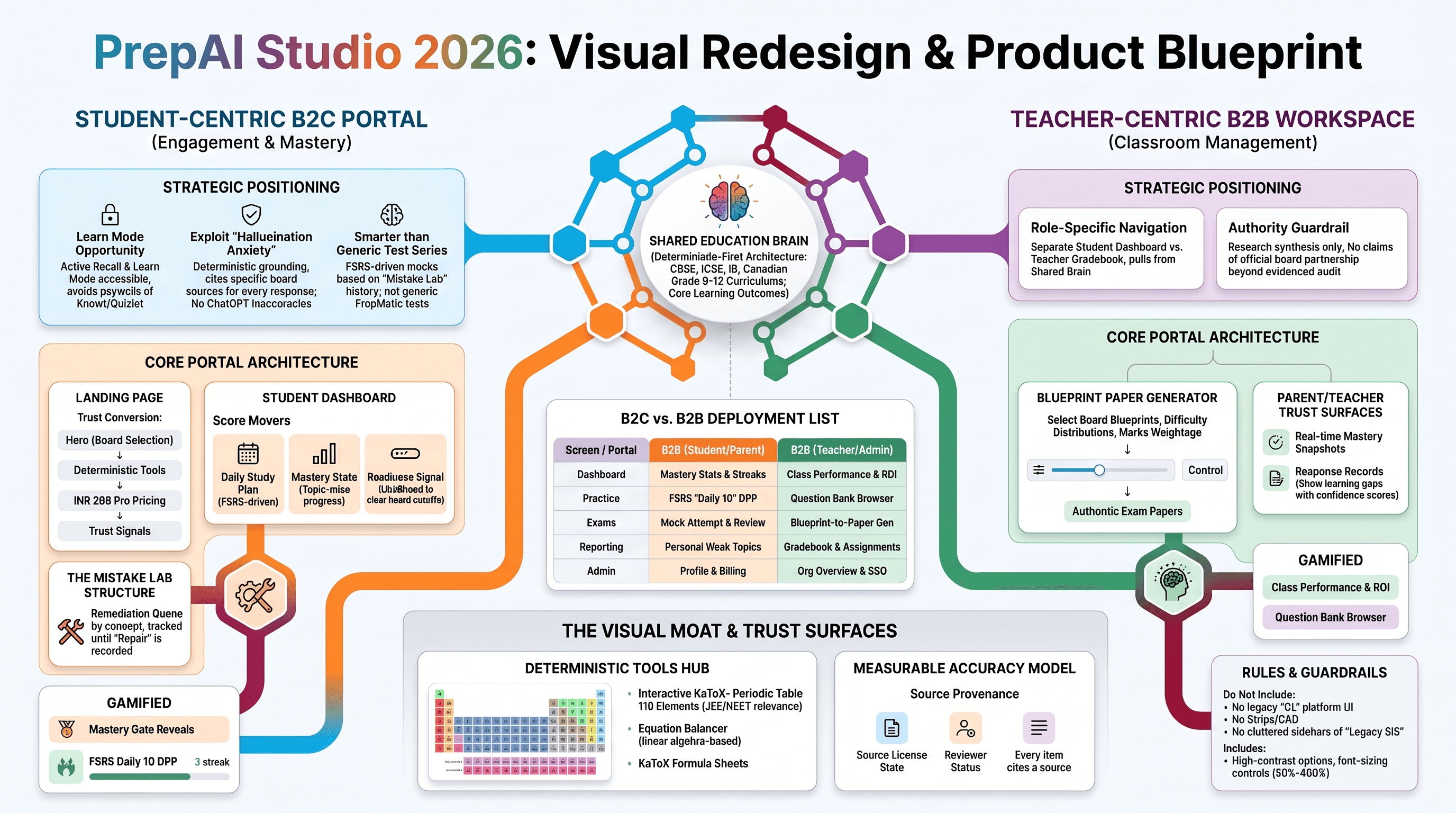
Source-safe curriculum graph
Chapters, topics, outcomes, prerequisites, formulas, source locators, and review states stay connected before any item reaches practice.
Deterministic exam compiler
Board-style papers are compiled from reviewed questions, section rules, marks, difficulty mix, and answer-key separation.
Spaced repair loop
Mistakes stay open until retrieval succeeds, so the system repairs root causes instead of treating explanation reading as mastery.
Shared teacher and parent views
Student, teacher, and parent workspaces read the same mastery, mistake, source, and readiness data at the right permission level.
Parent trust
Verify the source before you trust it
Parents can check whether a practice question has an approved NCERT coordinate, source metadata, and review status without exposing raw answer keys.
NCERT source verification
Enter a PrepAI question ID to check its approved textbook coordinate and source hash status.
Trust constraints
Parents can inspect source coordinates without exposing answer keys or copied textbook text.
Source-safe
Official sources guide structure and coordinates; PrepAI content stays coordinate-based.
Deterministic tools
Chemistry calculators and paper compilation use local rules, not runtime AI guesses.
Answer-masked
Answers, explanations, and rubrics stay locked until the student commits a response.
Review-gated
Questions must pass content review before DPP, practice, assignment, or mock use.
Secure rendering
Formula rendering uses KaTeX with trust:false and unsafe math commands blocked.
Verification contract
- - Question ID maps to a reviewed PrepAI content item.
- - The item has an NCERT chapter, section, and coordinate locator.
- - Source hash or source-record status is visible without exposing textbook text.
- - Answer keys, rubrics, and explanations remain outside parent lookup.
Sample coordinate shape
CBSE-12-CHEM-CH2 / Nernst equation / NCERT Chemistry-I Chapter 2 section locator / hash status pending or verified.
Explore offline studyDesktopOpen
Sovereign Offline Desktop App & Free Local LLM Ownership Hub
Own the desktop app once for unlimited offline study, or subscribe on the cloud for multi-device sync
Compare why our installed desktop app carries zero monthly question limits forever while the hosted web platform runs as a monthly cloud subscription.
Install Prep AI Studio on your Windows or macOS computer and run unlimited step-by-step rubric grading, mock papers, and local AI explanations offline forever.
Because 100% of deterministic CBSE/JEE/NEET step-by-step math, chemistry, and physics solvers, local SQLite FSRS-5 spaced-repetition scheduling, and free open-source local LLMs (via Ollama and whisper.cpp on 127.0.0.1:11434) execute on your own computer hardware, it costs our studio $0.00/month in cloud server or token fees.
- 100% offline CBSE/JEE/NEET step-by-step rubric grading with zero monthly question cap
- Offline practical Viva voice examiner powered by local whisper.cpp and < 3 KB rubric JSON fact sheets
- Local AES-256-GCM SQLite FSRS-5 spaced-repetition deck stored privately on the student's own disk
- Deterministic CPU solver never lets the language model invent marks, constants, or reaction stoichiometry
Desktop installer packaging and Ed25519 offline licence signing remain in preparation (`scaffold_only`). No unsigned installer binary is offered as a finished download.
Tauri v2 Sovereign Workstation · Loopback 127.0.0.1:11434
Local Open-Source LLM & Offline Viva Voice Hardware Selector
Every numerical calculation, Nernst equation step, stoichiometry balance, and mark allocation runs 100% deterministically on your CPU first. The local open-source language model at 127.0.0.1:11434 receives only a < 3 KB deterministic JSON rubric fact sheet (< 8 GB -> llama3.2:1b · 8-16 GB -> llama3.2:3b · 16+ GB -> qwen2.5-math:7b + whisper.cpp) so it never invents numbers or marks.
Selected Hardware Profile: 16 GB RAM -> Qwen 2.5 Math 7B + Whisper.cpp
Contract tier mapping: 16+ GB -> qwen2.5-math:7b + whisper.cpp offline Viva voice examiner
1-Click Local Loopback Model Command
ollama run qwen2.5-math:7bOffline Viva Voice & Fact-Sheet Gate
whisper.cpp small/turbo offline Viva voice examiner · < 3 KB deterministic JSON rubric fact sheet
- 100% offline CBSE/JEE/NEET step-by-step rubric grading across physical, organic, and inorganic numericals
- Offline practical Viva voice practice (salt analysis, titration, functional group tests) via local whisper.cpp
- Local SQLite FSRS-5 spaced-repetition storage with printable board-format mock paper compilation
Installer status: source contract & scaffold verified (`in-preparation`)
The Windows & macOS desktop installer is being prepared
The deterministic rubric engine, FSRS-5 spaced-repetition scheduler, and loopback local LLM contract (`desktop/distribution-contract.json`) are defined in source. We do not publish an unsigned installer link before these release gates close:
- Windows Authenticode and macOS notarization certificates are being provisioned so SmartScreen and Gatekeeper can verify the publisher signature.
- The device-bound Ed25519 offline licence key ring (`one_time_offline_license`) is held behind `desktop_license_activation` approval so every issued licence verifies offline.
- The Tauri v2 shell (`desktop/src-tauri`) and deterministic Python/CPU rubric sidecar (`no_backend_fork`) are being packaged into a single one-click installer.
Published by The Million Dollar AI Studio Ltd.. While the signed desktop installer is in preparation, you can run all deterministic Chemistry calculators, equation balancers, and rubric X-Ray previews right here in your browser.
What works on your computer without the internet vs. the online cloud plan
Every workflow that runs on your own processor and local open-source LLM carries no monthly count on a one-time desktop licence. Only features that use our hosted cloud servers require a monthly cloud subscription.
CBSE/JEE/NEET step-by-step rubric grading & equation balancing
Deterministic Python/CPU solver checks formula setup, substitution, units, sign conventions, and reaction stoichiometry locally.
On this computer · No monthly limit
Online plan allowance (5 questions/day on Free tier; metered on cloud)
Local AI Socratic explanations (Ollama loopback 127.0.0.1:11434)
Reads only the < 3 KB deterministic JSON rubric fact sheet (`llama3.2:1b`, `llama3.2:3b`, `qwen2.5-math:7b`, or `DeepSeek-R1-Distill-14B`) with post-generation hallucination verification.
On this computer · No monthly limit ($0/mo local LLM)
Online plan allowance (consumes managed cloud AI tokens)
Offline practical Viva voice practice (whisper.cpp)
Practise salt-analysis, titration, and practical Viva questions aloud on your own PC without sending student voice recordings to a third-party cloud.
On this computer · No monthly limit
Online plan allowance (requires cloud audio upload)
Local SQLite FSRS-5 spaced-repetition deck & printable mock papers
Stores card stability, 48h Smart Retry queues, and printable 70-mark exam papers in an encrypted local SQLite vault on your machine.
On this computer · No monthly limit
Online plan allowance
Multi-device cloud sync, parent portal & classroom teacher heatmaps
Synchronizes student mastery across phones/laptops and powers live school-wide teacher assignment dispatch.
Needs the internet (Optional Monthly Cloud Companion)
Included in Monthly Cloud Subscription
A one-time desktop licence covers your owned major version permanently with an advisory 90-day check-in that never switches off local step-by-step grading, local SQLite FSRS-5 decks, or local Ollama / whisper.cpp explanations.
Fail-closed conversion
Plan State
Free tools and the daily loop exist in the current source; live availability remains unverified. Paid checkout stays locked until provider verification is complete.
Free
source-tested; provider state unverified
Free
- 5 practice questions/day
- All deterministic tools
- Periodic table
- Equation balancer
- Named reactions
Pro
provider verification pending
Pilot opening soon
- Unlimited practice
- Exam paper generation
- FSRS spaced repetition
- All question types
- Reveal-after-commit explanations
- Progress analytics
Institution
provider verification pending
School pilot pending
- Everything in Pro
- Teacher heatmaps
- Assignment dispatch
- Classroom misconception clusters
- Review-gated question bank